The Judgment Embedded in the Dial: Mechanical Instruments, Digital Sensors, and the Disappearing Epistemology of Measurement
The Instrument as Argument
A mercury thermometer is a philosophical object. Its operation depends on a theory of thermal expansion, a decision about which properties of matter to treat as proxies for temperature, and a set of calibration practices that embed the instrument in a web of prior measurements and theoretical commitments. None of this is visible when someone reads the number on the glass. But it is all there, encoded in the instrument's design, waiting to become relevant the moment the instrument is used outside the conditions for which it was calibrated or the moment its readings are contested.
This is what it means to say that an instrument embodies a theory. The claim is not merely that instruments are built using scientific knowledge—that is trivially true. It is that the act of measuring, performed through any instrument, involves theoretical commitments that shape what can be measured, how the results are to be interpreted, and what counts as an anomaly requiring explanation. These commitments are epistemological before they are technical, and their history is inseparable from the history of scientific knowledge itself.
The transition from mechanical to digital instrumentation that transformed American laboratory practice across the latter decades of the twentieth century was, among other things, a transformation in where these commitments were located and how visible they were to the scientists who depended on them. Understanding what changed—and what was lost—requires attending to the philosophical character of the instruments that were displaced.
What Mechanical Instruments Made Visible
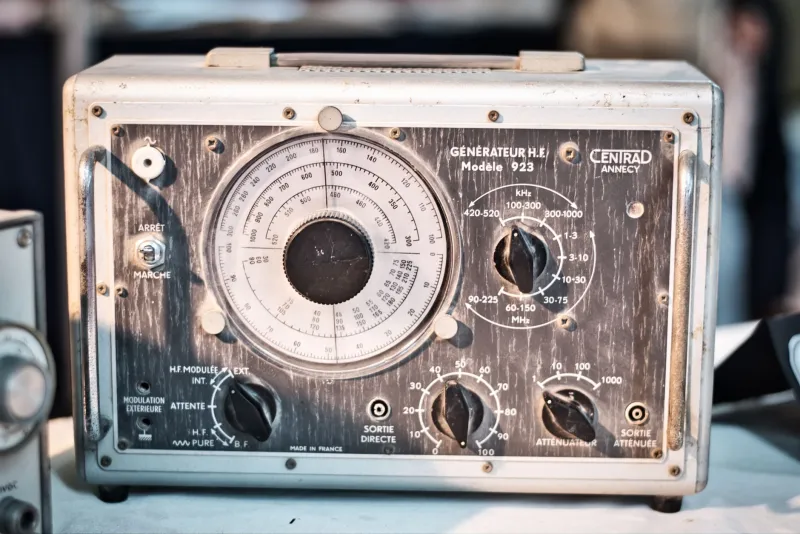
The great mechanical instruments of classical laboratory science—the balance, the galvanometer, the interferometer, the oscilloscope with its phosphorescent trace—shared a feature that is easy to overlook precisely because it was so thoroughly taken for granted by the scientists who used them. They made their own uncertainty legible. The needle of a galvanometer trembled; the beam of a balance settled slowly, its final position a negotiation between competing forces; the interference fringes on an optical bench shifted with vibration and thermal drift. These behaviors were not failures of the instruments. They were the instruments communicating information about the conditions of measurement—information that a skilled operator could read, interpret, and incorporate into an assessment of the result's reliability.
This legibility had epistemological consequences. It meant that the relationship between the instrument and the phenomenon being measured was, to a significant degree, transparent. The operator could see the instrument working, could observe its responses to disturbance, could develop through practice an intuitive model of its behavior under different conditions. This transparency supported what philosophers of science sometimes call tacit knowledge: the practical understanding of a measuring system that cannot be fully articulated in a manual but that is essential to using the system well.
The training of American laboratory scientists in the first half of the twentieth century was organized, in part, around the cultivation of this tacit knowledge. Students learned to use instruments by using them—by reading the needle, adjusting the balance, interpreting the trace—in a process that was simultaneously technical and epistemological. They were learning not just how to operate a device but how to think about measurement: what sources of error to anticipate, what patterns of behavior to trust, what anomalies to investigate.
The Digital Displacement
Digital instrumentation did not eliminate the theoretical commitments embedded in measurement. It relocated them. The analog-to-digital conversion that lies at the heart of every digital sensor involves a series of decisions—about sampling rates, signal filtering, threshold values, and numerical representation—that are every bit as theory-laden as the design of a mechanical balance. The difference is that these decisions are made by engineers at the time of instrument design rather than by scientists at the time of measurement, and they are typically implemented in firmware or software that the end user cannot inspect and may not know exists.
This relocation has a name in the philosophy of technology: it is a form of inscription, the encoding of values, assumptions, and choices into the design of a technical artifact in ways that constrain the artifact's subsequent use. What makes digital inscription epistemologically significant is not that it occurs—inscription occurs in mechanical instruments as well—but that it is systematically less visible to the scientists who depend on it. The digital instrument presents its output as a number, stripped of the behavioral cues that a mechanical instrument would provide about the conditions and quality of the measurement.
The result is what might be called an illusion of objectivity. The numerical precision of a digital readout—four decimal places where a mechanical instrument might have given two—creates an impression of certainty that the underlying measurement may not support. American laboratory culture, already inclined toward the quantitative, proved susceptible to this impression. The clean number on the screen displaced the trembling needle as the paradigmatic image of measurement, and in doing so, it displaced the epistemological humility that the trembling needle had enforced.
The Intensification of Interpretive Labor
The concealment of uncertainty in digital instrumentation does not make that uncertainty disappear. It defers and intensifies the epistemological work required to interpret results. Scientists working with digital data must grapple with questions that their predecessors resolved through direct observation of instrument behavior: Is this signal genuine or artifactual? Is this pattern a feature of the phenomenon or a consequence of the sampling algorithm? Is the precision of this readout meaningful or illusory?
These questions are not new. But the resources available for answering them have changed in ways that are not always recognized. The tacit knowledge that supported the interpretation of mechanical instruments was developed through direct, embodied engagement with the measuring system. The knowledge required to interpret digital data is often statistical and computational—it is knowledge about signal processing, about the behavior of algorithms, about the properties of numerical representations. This knowledge is no less valid than its predecessor, but it is differently distributed, differently taught, and differently vulnerable to error.
American scientific training has been slow to reckon with this shift. Laboratory curricula that once devoted substantial attention to instrument behavior and calibration now often treat data acquisition as a solved problem—a black box that can be trusted to deliver reliable output. This trust is not always warranted, and the cases in which it has been misplaced have contributed to some of the more consequential failures of replication and reproducibility in recent American science.
Recovering the Philosophy of the Dial
None of this is an argument for a return to mercury thermometers or mechanical balances. Digital instrumentation has enabled forms of measurement that were simply impossible with mechanical devices, and the scientific knowledge produced with its assistance is genuine and valuable. The argument is rather that the transition from analog to digital measurement involved a philosophical change that has not been adequately theorized or incorporated into scientific education and practice.
The dial, the needle, and the trembling beam were not merely primitive precursors to the digital readout. They were epistemological teachers, communicating through their behavior information about the conditions and limits of measurement that scientists learned to read and to trust. When those teachers were replaced by silent numerical displays, the lessons they taught did not become unnecessary. They became invisible—and invisibility, in the history of scientific epistemology, is rarely a neutral condition.